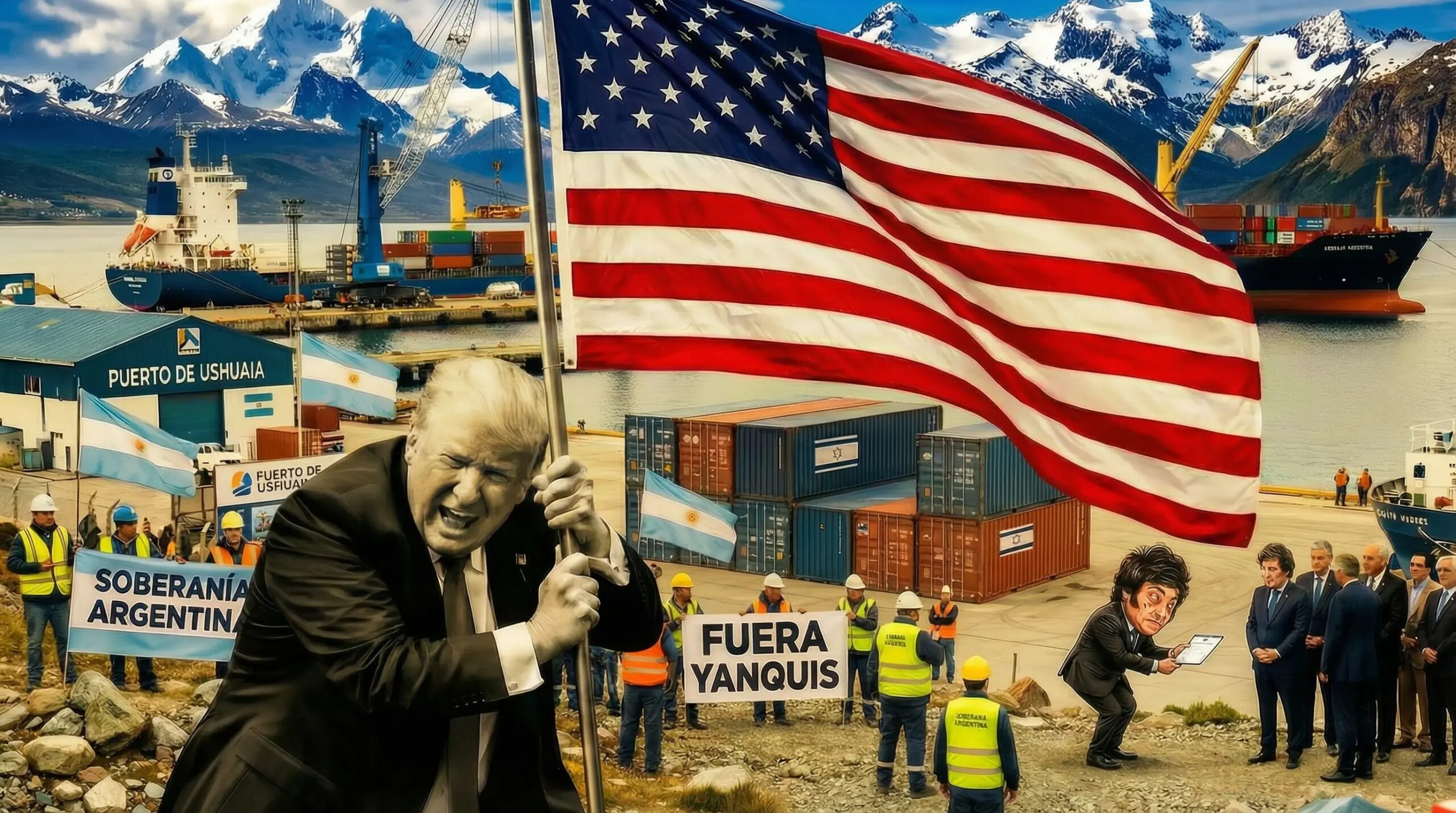
Freddie Ponton
21st Century Wire
At the southern edge of the continent, where the Andes dissolve into the sea, and Antarctica feels closer than Buenos Aires, the Port of Ushuaia has always been more than infrastructure. It is geography made political., with sovereignty poured into concrete. A gateway not just to commerce, but to the South Atlantic, the Antarctic, and the long, unresolved question of who controls the southern hemisphere’s future. That is why what is unfolding today in Ushuaia cannot be understood as a routine administrative intervention. It is the latest chapter in a familiar South American story, one where strategic assets are declared deficient, stripped from local hands, and quietly repurposed to serve foreign interests under the language of efficiency, modernisation, or so-called peace.
Argentine politician and former Minister of Agrarian Affairs Alejandro “Topo” Rodríguez’s warning cuts through the fog: Yesterday, he announced via his social media account on X, that Argentina did not pay the billion dollars demanded to join Donald Trump’s so-called “Board of Peace” which was officially launched during the 56th annual meeting of the World Economic Forum, held in Davos, Switzerland. Instead, Argentina is paying with territory.
MILEI FIRMÓ SU ADHESIÓN A LA “JUNTA DE PAZ” QUE ARMÓ TRUMP Y OFRECIÓ EL PUERTO DE USHUAIA
Fue en Davos. Argentina no aportará los 1.000 millones de dólares que exige Donald Trump para ingresar. A cambio, ofrece el Puerto de Ushuaia. https://t.co/9ZFSpxqoJP pic.twitter.com/T0QdcMyFe9
— TOPO Rodríguez (@TOPOarg) January 22, 2026
If we are to believe Alejandro Rodríguez’s statement, and there is no reason we shouldn’t, the exchange, or barter, did not take place on the docks of Ushuaia, nor in the legislature of Tierra del Fuego. It unfolded thousands of kilometres away, in Davos, amid snow-covered mountains and sealed conference rooms where power is traded in gestures and silence. There, President Javier Milei accepted Trump’s invitation to join the newly created Board of Peace, an initiative marketed as a platform for global stability but strangely structured as a real estate consortium, entirely outside the traditional architecture of international diplomacy. The price of admission was steep—one billion dollars, yet Argentina did not pay it.
READ MORE: From Board of Peace to Board of Profit: Trump, Kushner, and the Gaza Master Plan Fantasy
Official statements and reports celebrated the savings. The country, they said, would not part with scarce funds during a time of economic adjustment. What they did not explain was how Argentina secured its seat at the table regardless.
That silence was broken not by a leak from within the government, but by a post on X from Alejandro “Topo” Rodríguez, a veteran Peronist politician, former national deputy, and current director of the Instituto Consenso Federal. Rodríguez is not an outsider throwing stones. His career spans legislative work, executive administration, and policy analysis. His message was blunt: Milei compensated for the unpaid billion dollars by offering the Port of Ushuaia.
The Federal Takeover and Legal Shockwaves
Days before Milei’s appearance in Davos, where he was knighted as a member of Trump’s “Board of Peace”, the Argentine federal government moved to intervene in the Port of Ushuaia, displacing provincial authority and placing the facility under direct national control in a surprise federal operation that saw national port officials and “Prefectura Naval” take over the terminal, without prior warning to local workers, provoking protests and labor unrest among dockworkers and families dependent on the port’s operations.
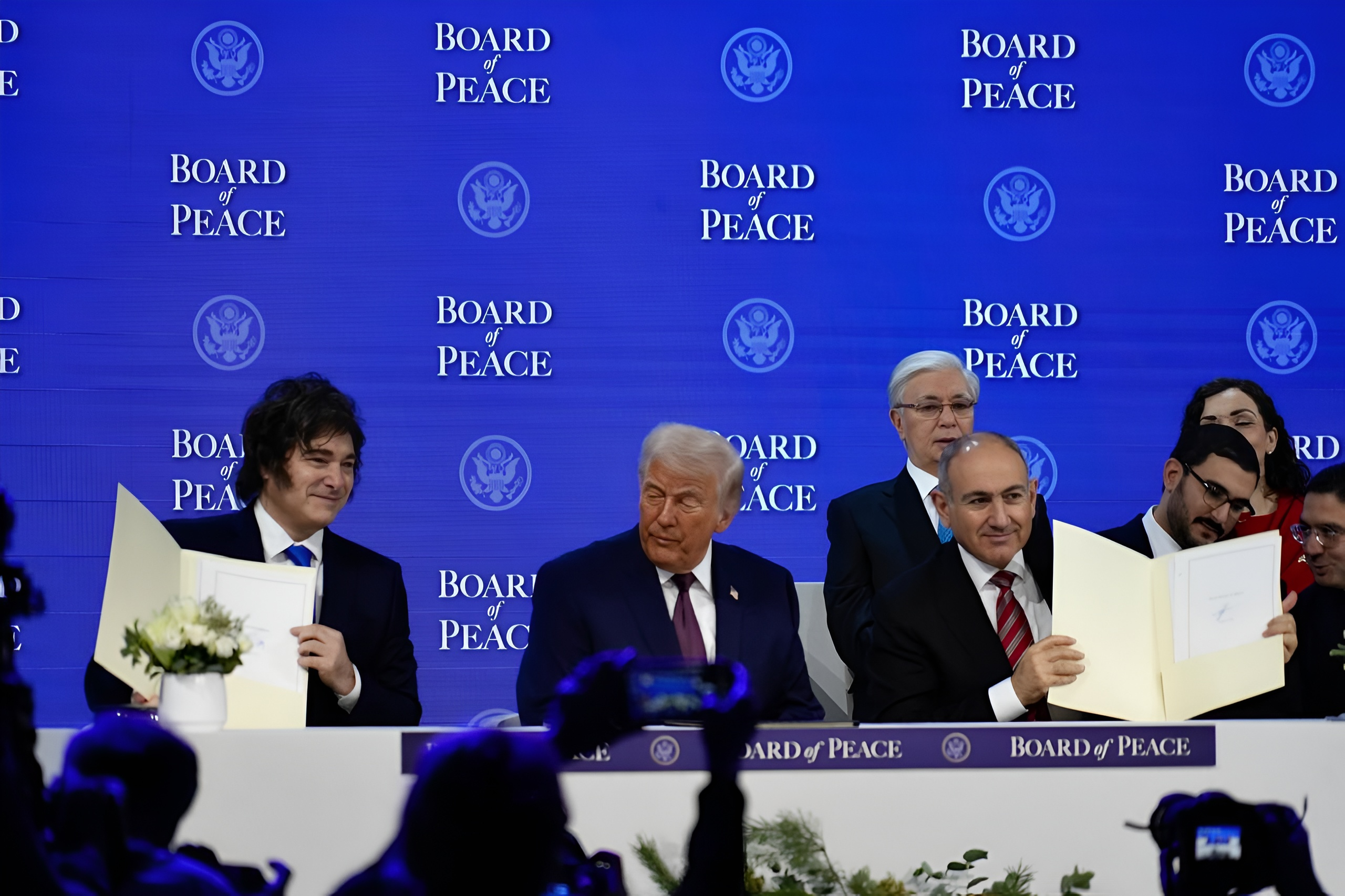
IMAGE: Milei officially signed Argentina’s entry into Trump’s “Board of Peace”, during the World Economic Forum annual aeeting Davos.
The move was framed by officials as temporary, technical, and unavoidable. Yet timing is never neutral in politics. A port that had belonged to Tierra del Fuego was suddenly centralised, neutralised, and administratively detached, just as Argentina entered negotiations that elevated its strategic value.
The legal scaffolding for this intervention was not improvised. Resolution 4/2026 of the Agencia Nacional de Puertos y Navegación (ANPyN), signed by Iñaki Arreseygor and published in the Boletín Oficial on 20 January 2026, formally authorised the federal takeover of the port. The resolution cites the Port Activities Law (Ley de Actividades Portuarias N° 24.093), its regulatory decree, and historical transfer agreements between the national government and the Province of Tierra del Fuego as the legal foundation for intervention. It references inspection reports, structural assessments of the docks, and provincial financial management issues as justification, while empowering ANPyN personnel to assume full operational control for an initial period, extendable at the national authority’s discretion.
DOCUMENT: Argentina National Ports And Navigation Agency Resolution 4/2026 – Translate from Spanish to English. (Source: Boletin Oficial)
aviso_337630.es.en
The intervention was executed in the early hours of 21 January 2026, with federal port officials and Prefectura Naval swiftly assuming control of administrative and operational areas and removing workers from their posts. The abrupt action triggered protests and labour unrest, with workers blocking access to cruise operations as they expressed profound uncertainty over their jobs and livelihoods, and union representatives condemned the federal act as a unilateral power grab.
While the government defended the takeover on technical grounds, citing financial irregularities and alleged structural issues at the port, the timing of its publication and execution, just before Milei’s diplomatic engagements in Davos, reinforces critics’ interpretations that the federal takeover was strategic rather than merely administrative.
Rodríguez’s account of the events underscores this interpretation. He describes the takeover as an act in service to Trump, framing the measure as a dangerous precedent that bypasses provincial autonomy to serve foreign powers’ strategic objectives. Governor Gustavo Melella of Tierra del Fuego condemned the federal action as irresponsible and unwarranted, arguing the port was functioning normally while criticising the national justification as overly broad and inconclusive.
The Strategic Value of Ushuaia in a Global Chessboard
For critics and local political actors, the intervention is seen not as a fix for administrative failings but as a prelude to privatisation or the placement of Antarctic logistics infrastructure under foreign influence, effectively diminishing Argentina’s voice in the governance of its southernmost port and the surrounding maritime theatre. To understand why Ushuaia matters to Trump, and to the constellation of interests aligned around his so-called ” Board of Peace”, one must look beyond Argentina’s borders and toward the map itself.
Ushuaia sits at the threshold of the Drake Passage, the narrow, turbulent corridor connecting the Atlantic and Pacific Oceans. It is the most direct logistical gateway to Antarctica. Control over this port does not merely facilitate trade or tourism; it shapes who supplies scientific missions, who supports naval logistics, who monitors fisheries, and who exercises practical authority over the southern oceans. The idea of building an Antarctic logistics hub in Ushuaia was first championed by then-President Alberto Fernández, who sought to secure Chinese funding to turn the southernmost city into a gateway for Argentina’s polar ambitions.”
Historically speaking, records show that President Milei travelled to Ushuaia, in the province of Tierra del Fuego, on Thursday, April 4, 2024. to expressly meet with the commander of the U.S. Southern Command, General Laura Richardson. It was against this backdrop that President Javier Milei announced the construction of an “integrated naval base” in Ushuaia, where Argentina and the United States could control the gateway to the white continent. In geopolitical terms, Ushuaia is leverage. For decades, the South Atlantic has been defined by asymmetry. To the east, the United Kingdom maintains a fortified military presence in the Malvinas (Falkland Islands), projecting power deep into the southern hemisphere. To the north, U.S. naval influence dominates Atlantic sea lanes. What has remained unresolved is the southern hinge, the logistical point that connects Patagonia, Antarctica, and inter‑oceanic transit. Ushuaia is that hinge.

IMAGE: In 2025, the new US Southern Command chief, Admiral Alvin Holse,y visited Argentina, where he met with President Javier Milei (Source: Mercopress)
By transferring control of the port away from provincial authorities and placing it within a federal framework aligned with Milei’s Atlanticist orientation, Argentina has effectively made Ushuaia available for integration into a broader strategic network. This is not an occupation in the classical sense. No foreign flag flies over the dock. Instead, it is something more contemporary and more subtle: interoperability, access, and alignment at the cost of sovereignty.
This is where the language of the “Board of Peace” becomes revealing. Peace, in this context, does not mean neutrality. It means military subordination and order, and historically, both have always required logistics. Trump’s initiative is not anchored in the United Nations or any multilateral consensus. It is personal, transactional, and explicitly hierarchical. Participation is granted not based on shared norms, but on alignment with U.S. and Israel strategic priorities. Argentina’s inclusion without payment was not an act of generosity. It was recognition of value.
Milei did not save a billion dollars. He prepaid with geography.
Israel’s interest in Patagonia and Antarctic logistics further complicates the picture. For years, Israeli state-linked and private actors have invested heavily in southern Argentina, from land acquisitions to technological and security partnerships. Israel’s Antarctic ambitions, scientific, logistical, and strategic, require southern access points. Ushuaia is not merely convenient; it is indispensable. Water infrastructure projects, land management ventures, and the relocation of scientific institutes have given Israeli actors footholds in the extreme south, complementing the strategic overlay that the United States is constructing. Together, they form a network that extends from Tierra del Fuego to the Antarctic Peninsula.
Seen through this lens, the move also echoes the logic of the so-called Isaac Accords, a framework through which strategic alignment, security cooperation, and resource access are bundled under the language of peace. In the southern cone, that alignment increasingly points southward, where ports, logistics corridors, and Antarctic gateways matter more than declarations.
SEE MORE: The Rise of the Isaac Accords: How Israel is Redrawing South America’s Political Landscape
The Southern Atlantic Jaw and the Imperative of Defense
This vision of Ushuaia is now becoming a reality on the ground. Argentina has advanced the construction of an integrated naval base in Tierra del Fuego in collaboration with the United States, designed to support Antarctic operations, secure naval logistics, and project allied power across the southern oceans.
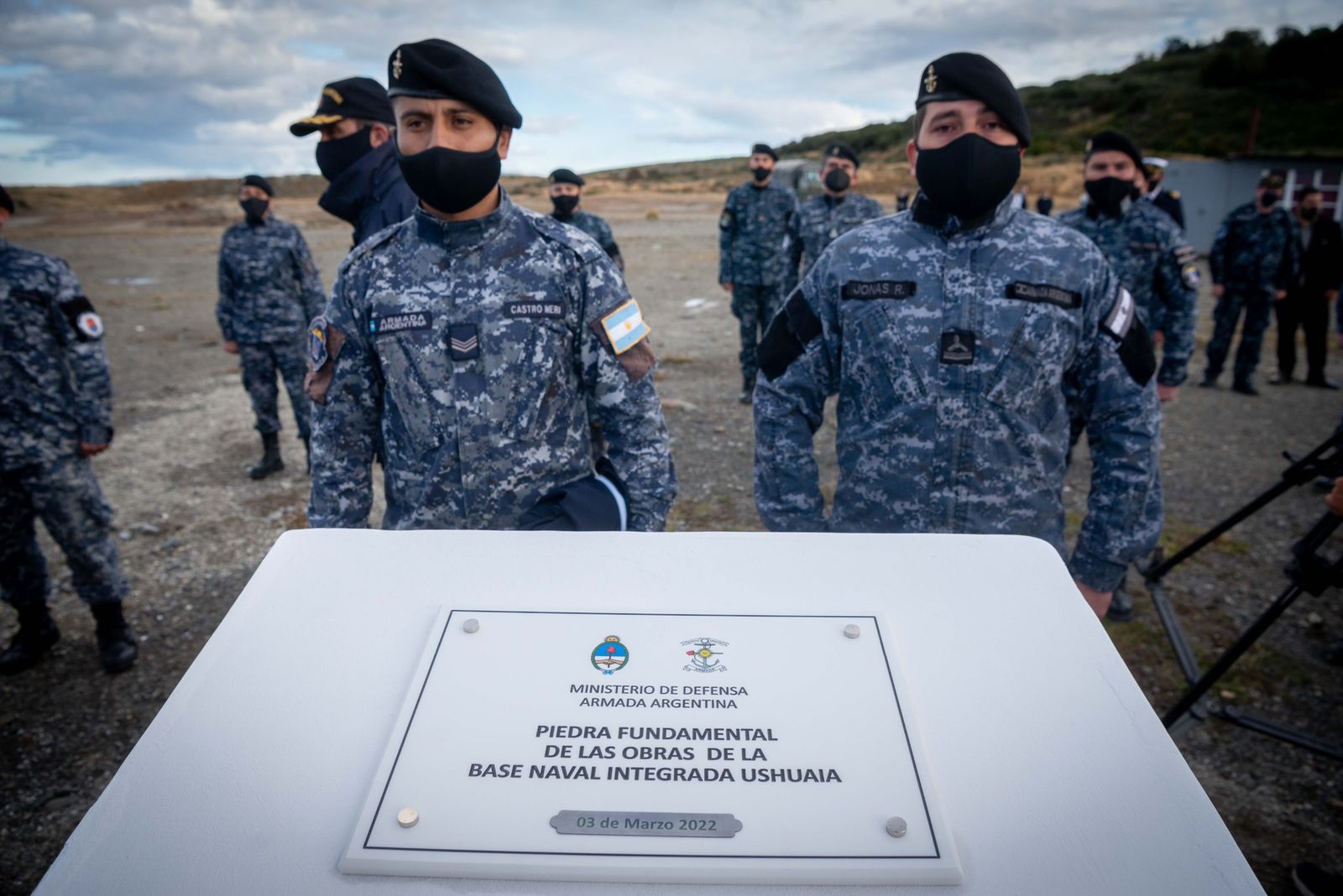
IMAGE:Integrated Naval Base Almirante Berisso in Ushuaia, Tierra del Fuego. It is the southernmost port of the Argentina Navy in Argentine sector of the Beagle Channel (Source: Argentina Gob)
In parallel, Argentina is planning a major Antarctic logistics centre in Ushuaia, relocating housing and operational facilities for military and scientific personnel, constructing laboratories, fuel depots, and aviation hangars, and moving the Argentine Antarctic Institute closer to the port, efforts that underscore Ushuaia’s significance not just as a local asset, but as a node in global strategic competition.
Chile’s competing logistics infrastructure in Punta Arenas underscores that Antarctica is no longer a distant scientific preserve. It is a theater of active interest for global powers. In this context, Milei’s handover of the port to Trump’s Peace Board is not symbolic. It is transactional: control of the southern gateway, the Drake Passage, and the Antarctic supply chain are being woven into a strategic network that consolidates U.S. and allied influence in ways that leave Argentine sovereignty increasingly contingent.
The Southern Atlantic pincer is now visible: British control in the Malvinas, U.S.-aligned operations in Ushuaia, and Israeli strategic footholds in Patagonia and Antarctic logistics. All converge on a single point: territory once managed by Argentina’s southernmost province, now positioned to serve the interests of foreign powers. This is the reality behind the language of efficiency, modernisation, and so-called peace.
For the people of Tierra del Fuego, the transformation is abstract but palpable. Decisions that once were local are now negotiated thousands of kilometres away. The port that connected them to the world increasingly connects the world to interests that do not include them. The language of peace offers little comfort when paired with the erosion of autonomy.
History offers no shortage of warnings. Across Latin America, strategic infrastructure has been surrendered not through invasion, but through invitation. Ports, bases, and corridors have been “shared,” “optimised,” and “integrated.” Each time, the promise is stability. Each time, the cost is “control”. Milei presents himself as a disruptor, a breaker of old paradigms. Yet in Ushuaia, he is following a well-worn script, one written not in Buenos Aires, but in the offices of those who see geography as profit and opportunities.
Argentina did not escape the billion-dollar fee. It converted it. The currency was not pesos or dollars, but access, alignment, and silence. The payment was not recorded in a ledger, but in the shifting balance of power at the end of the world.
Ushuaia is not an obsolete port in need of rescue. It is a strategic asset whose value has made it a target. To touch it is to alter Argentina’s place in the world. To give it away, explicitly or by design, is to accept a future where decisions about the South Atlantic and Antarctica are made elsewhere.
Peace, when it arrives on the deck of a port stripped of sovereignty, is not peace at all. Ushuaia is not to be offered; it is to be protected.
At the southernmost edge of Argentina, where glaciers meet the ocean, and the winds carry the weight of centuries, sovereignty is no longer abstract. It is measured in docks, in icebreakers, in who can sail unchallenged through the Drake Passage. Ushuaia stands at a crossroads: a city of commerce, science, and culture transformed into a chess piece in a global game. Every crane, every warehouse, every logistical decision now resonates far beyond the bay, signalling a quiet but profound shift in who will write the rules for the southern hemisphere. And for Argentina, the question remains: will it watch, or will it act?
READ MORE ARGENTINA NEWS AT: 21st Century Wire Argentina Files
SUPPORT OUR INDEPENDENT MEDIA PLATFORM – BECOME A MEMBER @21WIRE.TV
VISIT OUR TELEGRAM CHANNEL
21st Century Wire is an alternative news agency designed to enlighten, inform and educate readers about world events which are not always covered in the mainstream media.