Freddie Ponton
21st Century Wire
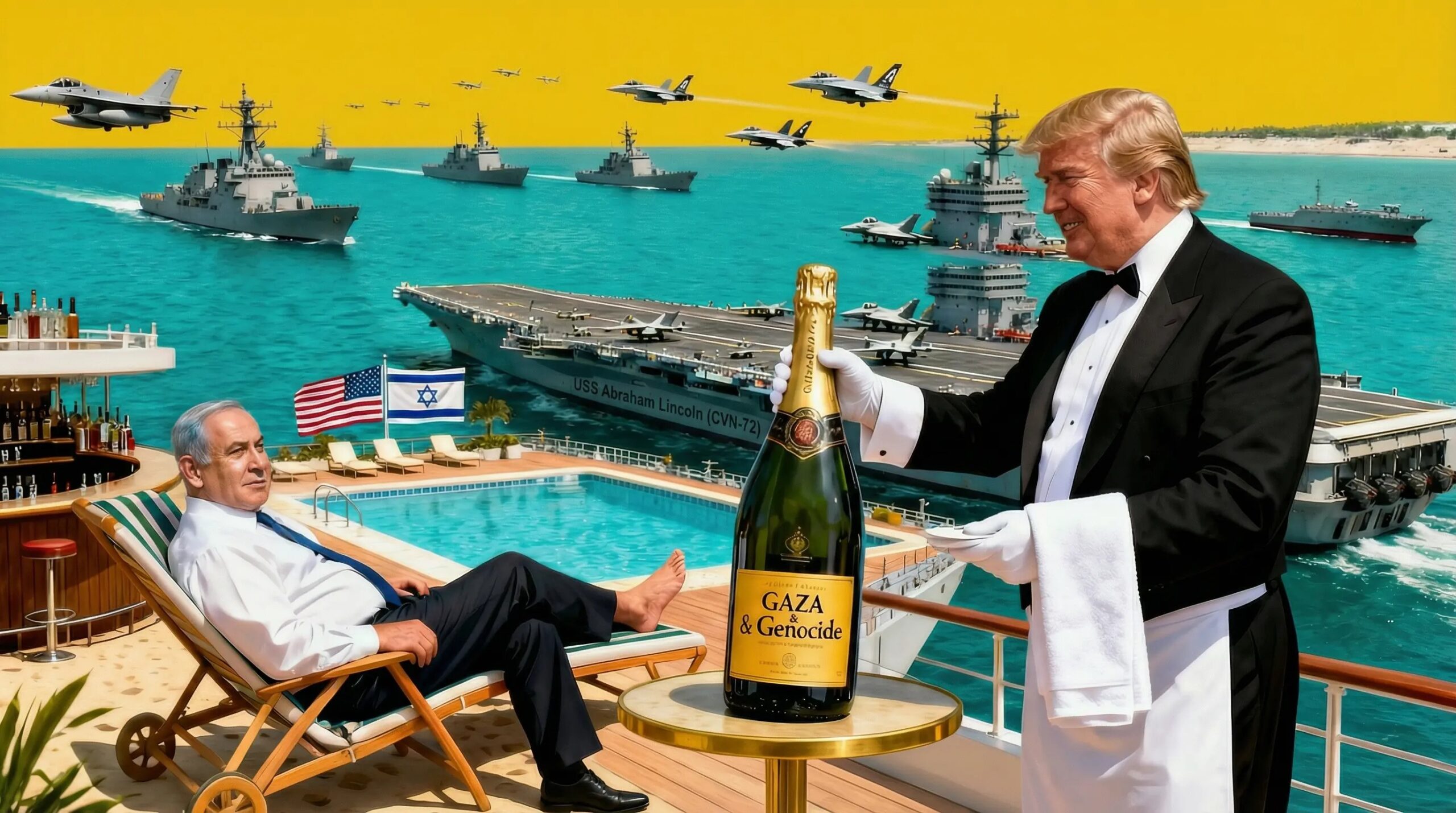
As the USS Abraham Lincoln carrier strike group slid quietly into the US Central Command’s area of operations, Washington insisted it was merely applying “pressure”, a familiar euphemism that has accompanied nearly every American war of the last three decades The decision to escalate toward war with Iran was not made on Truth Social, and it was not made in response to Iranian behavior. It was made quietly, bureaucratically, and long ago, inside the permanent machinery of American power, and in concertation with Israel.
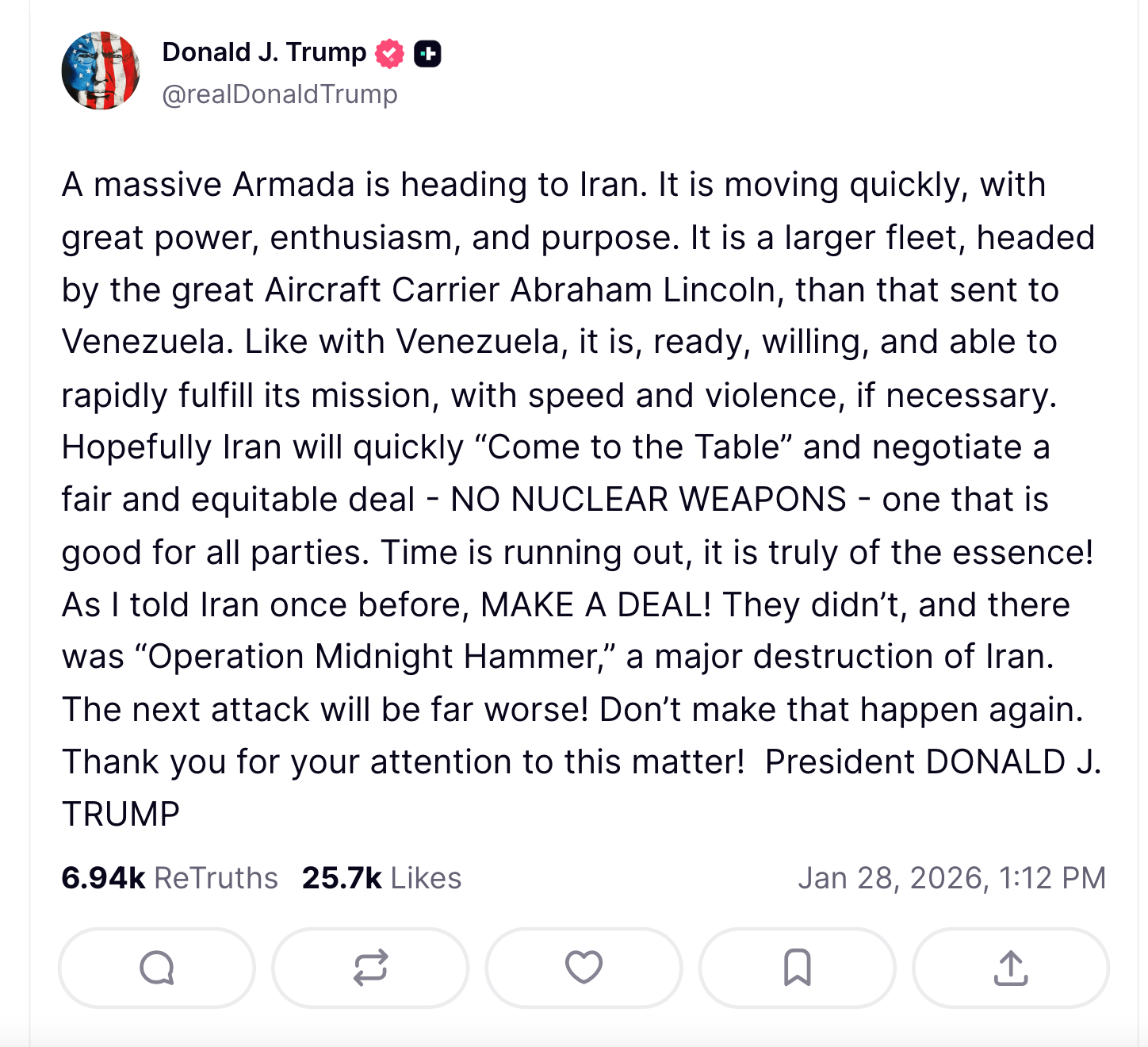
Donald Trump’s announcement of a “beautiful armada” steaming toward Iran was not a warning. It was a public signal that the Pentagon and the US national security state have moved from pressure to enforcement. Aircraft carriers do not reposition themselves for negotiations, and guided-missile destroyers do not assemble for confidence-building measures. What is now unfolding under US Central Command is a classic pre-war posture, the kind planners put in place when the political decision has already been taken, and the remaining task is narrative management.
At the centre of this operation sits US Central Command (CENTCOM), the same command structure that oversaw the wars in Iraq, Syria, and Afghanistan, conflicts that left millions dead and entire regions destabilised. CENTCOM’s leadership answers not to diplomacy but to the Pentagon, the National Security Council, and a revolving door of defense contractors, intelligence officials, and think tanks whose institutional survival depends on perpetual conflict.
The policy architecture is familiar. The talking points originate in Washington’s interventionist ecosystem, which includes, amongst many others, the American Enterprise Institute (AEI), the Foundation for Defense of Democracies (FDD), the Atlantic Council, and the Washington Institute for Near East Policy (WINEP), organisations deeply intertwined with Israeli security doctrine and funded by defense industry interests. These institutions have spent years portraying Iran as an existential menace while systematically erasing context, history, and international law from the discussion.
READ MORE: Iran Didn’t Erupt, It Was Ignited: The Hidden Hands Behind a Manufactured Crisis
Their arguments are then laundered through compliant media outlets in the like of The Financial Times, The Wall Street Journal, The Atlantic, and other pro-Israel network news, which dutifully frame a massive US military buildup as a “signal,” a “warning,” or a “pressure tactic,” never as what it is: a violation of the most basic principles of the UN Charter.
Article 2(4) of that charter is explicit. States are prohibited not only from using force, but from threatening it. There is no ambiguity. There is no exception for aircraft carriers, social media ultimatums, or presidential bravado. The mere deployment of an invasion-capable armada accompanied by explicit threats constitutes an illegal act under international law.
Iran has said this openly. Its UN ambassador, Amir Saeid Iravani, put it in writing to the Secretary-General and the Security Council: the United States is engaged in a flagrant breach of the Charter and will bear full responsibility for any “unpredictable consequences” that follow. Washington did not contest the legal argument because it could not. Instead, it ignored it, a tacit admission that law no longer constrains American power. This silence is the tell.
The White House claims Iran must accept a nuclear deal or face attack. But Iran has already rejected negotiations under coercion. Parliament Speaker Mohammad-Baqer Qalibaf has stated unequivocally that talks “under the shadow of war” are illegitimate. Foreign Minister Abbas Araghchi has reiterated that diplomacy conducted at gunpoint is not diplomacy at all. These positions were not misinterpreted; they were intentionally disregarded.
The “deal” Trump now brandishes is not meant to be accepted. It is meant to be refused, so that refusal can be retroactively cited as justification for war. This is clearly not negotiation; it is a setup. The same method was used against Iraq in 2003, Libya in 2011, and Syria throughout the last decade: impossible demands, followed by claims of non-compliance, followed by force. The deeper motive has nothing to do with nuclear weapons and everything to do with power.
Iran occupies one of the most strategically valuable positions on Earth. Located at a geopolitical hinge between East Asia, Central Asia, the Middle East, and Europe, Iran is indispensable to China’s Belt and Road Initiative, critical to Russia’s Eurasian integration strategy, and central to the emerging BRICS-aligned economic architecture and corridors that threaten US financial hegemony. Iran is not merely a state, but it is a node, and one that Washington does not control.
READ MORE: International North-South Transport Corridor (INSTC): The Underlying Causes of US-Iran Tensions
Add to this Iran’s vast oil and gas reserves, and the picture becomes unmistakable. Control Iran, and you choke off independent Eurasian development while reasserting dominance over global energy flows. This is not about democracy. It is not about human rights. It is about enforcing a hierarchy in a world that is slipping out of Washington’s grasp.
Trump, far from challenging this system, has become its most shameless salesman. Over the past year, his administration has greenlit covert military and intelligence operations in Ukraine that helped sabotage peace talks with Russia; continued unconditional military, financial, and diplomatic support for Israel’s destruction of Gaza; and quietly backed the political rehabilitation of Ahmad al-Sharaa (Abu Mohammad al-Julani), a former al-Qaeda commander, recast as a “moderate” leader to preside over a fragmented Syria amenable to Israeli territorial expansion.
Each of these actions violates international law. Each has been normalised. Iran is simply the next target in a continuum of managed chaos.
Israel’s role in this escalation is neither incidental nor reactive. It is strategic, deliberate, and rooted in decades of doctrine that treats Iran not as a rival state but as an existential obstacle to Israeli regional dominance.
For years, Israeli officials, from Prime Minister Benjamin Netanyahu to senior figures in Israel’s security establishment, have argued openly that Iran must be neutralised not through containment, but through internal collapse. Regime change, not deterrence, has been the consistent objective. When direct military action proved politically risky, the focus shifted to covert destabilisation, economic warfare, psychological operations, sabotage, and the cultivation of internal fault lines.
Israeli intelligence services, particularly the Mossad, have long specialised in this form of shadow warfare. Western and regional media have documented Mossad-linked operations inside Iran ranging from assassinations of nuclear scientists to cyberattacks, infrastructure sabotage, and influence campaigns aimed at inflaming social unrest. These efforts intensified during periods of economic pressure, when sanctions created fertile ground for internal instability.
Recent unrest inside Iran did not emerge in a vacuum. According to regional security sources and reporting from Middle Eastern outlets, foreign intelligence services exploited legitimate grievances to push unrest toward confrontation. Kurdish opposition factions operating along Iran’s western borders, some with well-documented ties to Israeli intelligence, played a visible role in attempting to internationalise the unrest and frame it as a precursor to regime collapse. The strategy was familiar, with a clear intent weaken the state internally, delegitimise it externally, and present its eventual destruction as inevitable.
The operation ultimately failed. Iran’s political system absorbed the shock, security institutions remained intact, and the anticipated cascade toward collapse never materialised. But failure did not mean abandonment. It meant escalation. This is where Washington enters, or more accurately, where it stops pretending to stay out.
While the Biden and Trump-era national security establishments publicly projected distance from Israel’s most aggressive impulses, the Pentagon was quietly repositioning assets, conducting “exercises,” and preparing the military infrastructure required for a direct confrontation. The choreography was intentional. Israel destabilises, the US “responds” to the resulting crisis, and the war is reframed as unavoidable rather than engineered.
In this division of labour, Israel supplies the provocation, the intelligence, and the strategic urgency, whilst the United States supplies the aircraft carriers, the missiles, and the diplomatic cover. The result is a war that serves Israeli security doctrine almost perfectly, while exposing American forces, taxpayers, and regional allies to catastrophic blowback.
What is sold to the public as deterrence is, in reality, the final phase of a campaign that failed to break Iran from within, and now seeks to do so by force.
Even regional powers allied with Washington understand the danger. Saudi Arabia and Turkey, often portrayed as rivals of Iran and not its defenders, have shown little enthusiasm for another US-engineered war. They know what the Pentagon refuses to admit, and understand that a strike on Iran would be extremely hard to contain. It would rupture energy markets, destabilise governments, and accelerate the collapse of the very order the US claims to defend. But somehow, the collapse is a risk the system is willing to take.
And yet, in the shadow of this carefully orchestrated brinkmanship, the world must remember that the true stakes are far higher than political games or strategic theatre. One miscalculation, one misread signal, could ignite a conflict that neither Washington, Tel Aviv, nor any regional ally can contain. Nuclear escalation is not a distant abstraction; it is a real, looming threat, and it is born from the same hubris that treats diplomacy as decoration and coercion as law.
The urgent message, one that must be heard by leaders and publics alike, is this: power enforced through fear is a brittle structure. It can be challenged not only by weapons or economic blocs but by a collective insistence on peace, negotiation, and adherence to international law. The alternative is annihilation for many, including soldiers, civilians, and the fragile promise of global stability.
The armada may be beautiful to those who command it. But to the rest of humanity, it is a warning. Not of Iran’s ambitions, not of regional instability, but of what the world looks like when war becomes policy and peace is treated as optional.
If diplomacy, restraint, and respect for sovereignty cannot be restored now, the consequences will extend far beyond one country or one crisis. The world cannot afford to watch the powerful enforce their will while the rest of us gamble with our collective survival. Peace is not weakness; it is the only insurance against a disaster none of us can survive.
READ MORE IRAN NEWS AT: 21st Century Wire IRAN Files
SUPPORT OUR INDEPENDENT MEDIA PLATFORM – BECOME A MEMBER @21WIRE.TV
VISIT OUR TELEGRAM CHANNEL
21st Century Wire is an alternative news agency designed to enlighten, inform and educate readers about world events which are not always covered in the mainstream media.